Because of this diverse audience, hospital cafeteria management requires careful planning around food quality, food safety, menu variety, staffing, production capacity, customer experience, and operational efficiency. A cafeteria must remain convenient and financially sustainable while meeting the standards expected within a healthcare environment.
For hospitals in the Philippines, partnering with an experienced food service provider can provide access to structured cafeteria operations, professional culinary teams, standardized food safety procedures, menu development, and scalable food production.
What This Guide Covers
- What hospital cafeteria management involves
- Why hospital cafeterias require specialized operations
- Key components of a successful hospital cafeteria
- Food safety and quality requirements
- Menu planning for healthcare facilities
- Staffing and operational considerations
- Hospital cafeteria outsourcing and concessionaire models
- How to evaluate a hospital cafeteria management partner
What Is Hospital Cafeteria Management?
Hospital cafeteria management involves the planning, operation, and continuous improvement of food service facilities within healthcare institutions. Depending on the hospital’s requirements, this may include menu development, food procurement, food preparation, staffing, customer service, sanitation, inventory management, equipment coordination, and daily cafeteria operations.A hospital cafeteria may operate as an employee dining facility, visitor dining area, public food outlet, concessionaire space, or a combination of these functions.
Unlike a typical commercial restaurant, a hospital cafeteria operates within an environment where food safety, cleanliness, reliability, and operational discipline are particularly important. The food service operation must also work around the hospital’s schedules, facility requirements, traffic patterns, and customer demographics.
Why Is Hospital Cafeteria Management Different?
Hospitals are active environments where people may enter and leave the facility at all hours. Healthcare workers may have limited time for meals, visitors may require convenient dining options, and hospital employees may depend on the cafeteria for regular meals during their shifts. This creates several operational requirements that are not always present in ordinary food service environments.| Requirement | Why It Matters |
|---|---|
| Food Safety | Healthcare food service operations require consistent food handling, sanitation, storage, and preparation controls. |
| Operational Reliability | Employees and visitors may depend on the cafeteria during defined breaks and extended operating hours. |
| Menu Variety | Different customers have different preferences, budgets, dietary considerations, and meal occasions. |
| Service Speed | Healthcare workers often have limited meal breaks and need convenient service. |
| Scalability | Meal demand can fluctuate depending on staffing levels, hospital activity, schedules, and visitor volume. |
| Customer Experience | A clean, organized, and convenient dining environment contributes to the overall experience of employees and visitors. |
Key Components of a Successful Hospital Cafeteria
An effective hospital cafeteria is built around several interconnected functions. Weakness in one area can affect the rest of the operation, which is why cafeteria management should be approached as an integrated food service system rather than simply as kitchen management.1. Menu Development
Hospital cafeteria menus should balance variety, nutritional considerations, customer preferences, affordability, ingredient availability, and operational practicality. Menus may include Filipino comfort food, international dishes, healthy meal options, snacks, beverages, and rotating daily specials. Menu cycles can also help maintain variety while making purchasing and production planning more predictable.2. Food Production
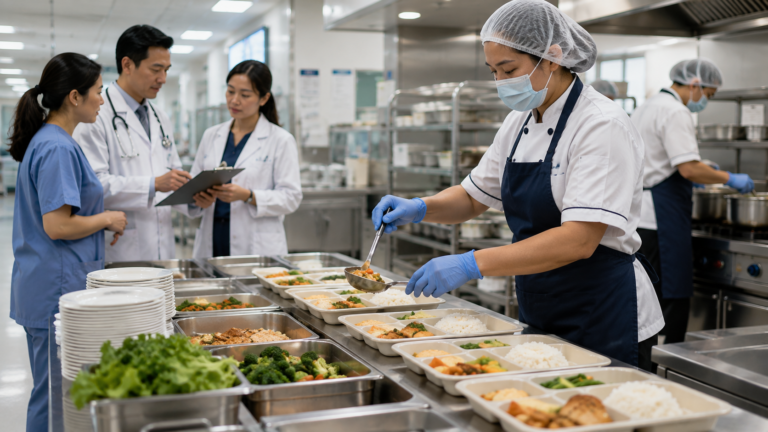
Consistent food production requires standardized recipes, appropriate preparation procedures, portion control, trained culinary personnel, and reliable ingredient sourcing. Production volumes should also correspond with expected customer demand. Preparing too little can result in stockouts and customer dissatisfaction, while excessive production can increase food waste and operating costs.3. Food Safety and Sanitation
Food safety should be integrated throughout the operation, from receiving ingredients through storage, preparation, cooking, holding, serving, and cleaning. The World Health Organization (WHO) food safety guidance emphasizes that food safety is a shared responsibility and that food can become contaminated at different points throughout the food chain. This makes consistent controls across procurement, preparation, handling, storage, and service particularly important for institutional food operations.4. Service Operations
The cafeteria’s front-of-house operation is equally important. Customers should be able to move through ordering, payment, food collection, seating, and disposal areas efficiently. Clear product displays, organized serving stations, adequate staffing, and well-designed traffic flow can reduce queues and improve the overall dining experience.5. Inventory Management
Inventory management helps maintain ingredient availability while controlling waste and unnecessary costs. Proper forecasting, stock rotation, purchasing controls, and monitoring of food usage can help cafeteria operators maintain a more efficient operation.Menu Planning for Hospital Cafeterias
One of the biggest challenges in hospital cafeteria management is serving a diverse customer base without creating an unnecessarily complicated operation. A well-designed menu can provide variety while maintaining manageable production requirements.A Balanced Hospital Cafeteria Menu May Include:
- Daily Filipino meal selections
- Rotating regional or international dishes
- Vegetable-based and lighter meal options
- Grilled or lower-fat selections
- Breakfast items
- Snacks and quick-service options
- Beverages and refreshments
- Grab-and-go meals for employees with limited break time
- Seasonal or promotional selections
Food Safety in Hospital Cafeteria Operations
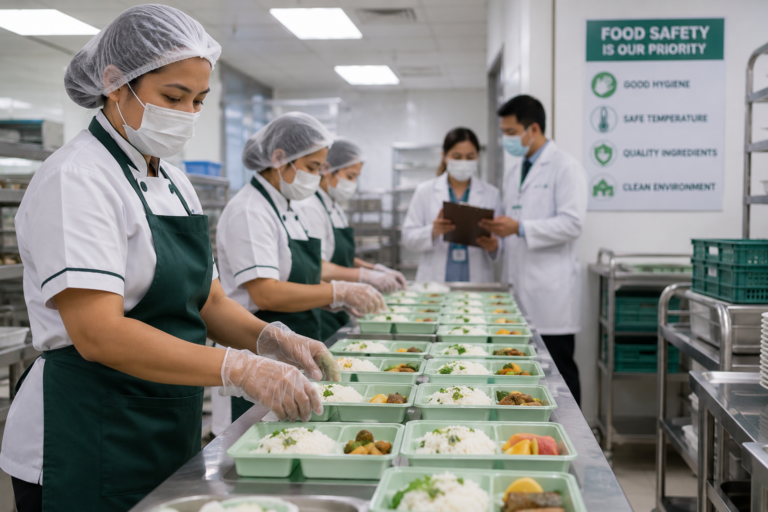
Food safety is one of the most important considerations when operating a cafeteria inside a healthcare facility. Hospitals serve people with different health conditions and levels of vulnerability, making consistent food handling and sanitation particularly important.The WHO Five Keys to Safer Food provide a practical framework for food handlers: keep clean, separate raw and cooked foods, cook thoroughly, keep food at safe temperatures, and use safe water and raw materials.
For a hospital cafeteria, these principles can support everyday practices covering food preparation, storage, cooking, holding, service, and employee hygiene.
Food safety controls should extend across the entire food service chain, including:
- Supplier and ingredient receiving
- Proper food storage
- Ingredient preparation
- Cooking and reheating
- Hot and cold holding
- Food display and service
- Employee hygiene
- Equipment sanitation
- Cleaning and waste management
- Documentation and quality monitoring
For Philippine food service operations, national food safety requirements must also be considered. The Food Safety Act of 2013 (Republic Act No. 10611) establishes the country’s food safety regulatory framework and aims to protect the public from food-borne and water-borne illnesses and unsafe food. Hospitals and their food service partners should therefore ensure that applicable food safety requirements are incorporated into their operations.
At the international level, the FAO/WHO Codex Alimentarius General Principles of Food Hygiene provides internationally recognized guidance on food hygiene measures and food safety controls. The Codex framework incorporates Good Hygiene Practices and a Hazard Analysis and Critical Control Point (HACCP) approach for identifying and controlling significant food safety hazards.
Together, these frameworks reinforce an important principle for hospital cafeterias: food safety should be integrated into everyday operations rather than treated as a separate administrative requirement.
Hospital Cafeteria Concessionaires vs. In-House Management
Hospitals generally have several options when structuring their cafeteria operations. They may operate the cafeteria internally, engage an external food service management company, or use a concessionaire model where an external operator manages the food outlet under agreed commercial and operational conditions.| Model | Potential Advantages | Considerations |
|---|---|---|
| In-House | Direct operational control and integration with existing hospital teams. | Requires internal staffing, procurement, culinary management, training, and operational oversight. |
| Outsourced Management | Access to specialized food service expertise, established systems, and professional culinary operations. | Requires clear service standards, performance monitoring, and coordination with the hospital. |
| Concessionaire | Can provide specialized food concepts and external operational expertise while expanding dining options. | The hospital must establish appropriate standards for food safety, service quality, operating hours, and customer experience. |
When Should a Hospital Consider Outsourcing Its Cafeteria?
Outsourcing may be worth evaluating when the hospital wants to improve cafeteria operations without expanding its internal food service infrastructure. Common reasons healthcare facilities may explore an external partner include:- Limited internal food service management resources
- Difficulty recruiting and retaining culinary personnel
- Inconsistent food quality
- Food safety or sanitation concerns
- High food waste
- Limited menu variety
- Long customer queues
- Difficulty managing extended operating hours
- Need for improved purchasing and inventory controls
- Plans to renovate, expand, or modernize cafeteria operations
Outsourcing should not simply transfer responsibility from one team to another. A successful partnership should establish measurable service standards, reporting procedures, food safety requirements, operating expectations, and mechanisms for continuous improvement.
How to Choose a Hospital Cafeteria Management Partner
Hospitals evaluating potential cafeteria operators should assess the provider’s ability to manage the complete food service operation rather than focusing only on menu pricing.| Evaluation Area | Questions to Consider |
|---|---|
| Healthcare Experience | Does the provider understand the operational requirements of healthcare facilities? |
| Food Safety | What food safety, sanitation, quality assurance, and monitoring systems are in place? |
| Culinary Capability | Can the provider develop varied menus while maintaining consistency and cost control? |
| Staffing | Can the provider recruit, train, schedule, and manage the personnel required for the operation? |
| Production Capacity | Can the operation scale during periods of increased demand? |
| Procurement | Does the provider have reliable sourcing and inventory management processes? |
| Performance Monitoring | Are there clear metrics for food quality, customer satisfaction, food safety, waste, and operational performance? |
| Customization | Can the provider adapt the operation to the hospital’s brand, customer demographics, schedules, and facility requirements? |
Hospital Cafeteria Management Should Go Beyond Serving Food
A successful hospital cafeteria is more than a place where people purchase meals. It is a service environment that supports healthcare workers, visitors, patients’ families, and other members of the hospital community.The strongest operations combine food safety, culinary quality, efficient service, reliable supply, appropriate pricing, menu variety, and consistent customer experience.
For hospital administrators and procurement teams, the right food service partner should therefore be evaluated based on its ability to manage the complete operation rather than simply its ability to provide meals.